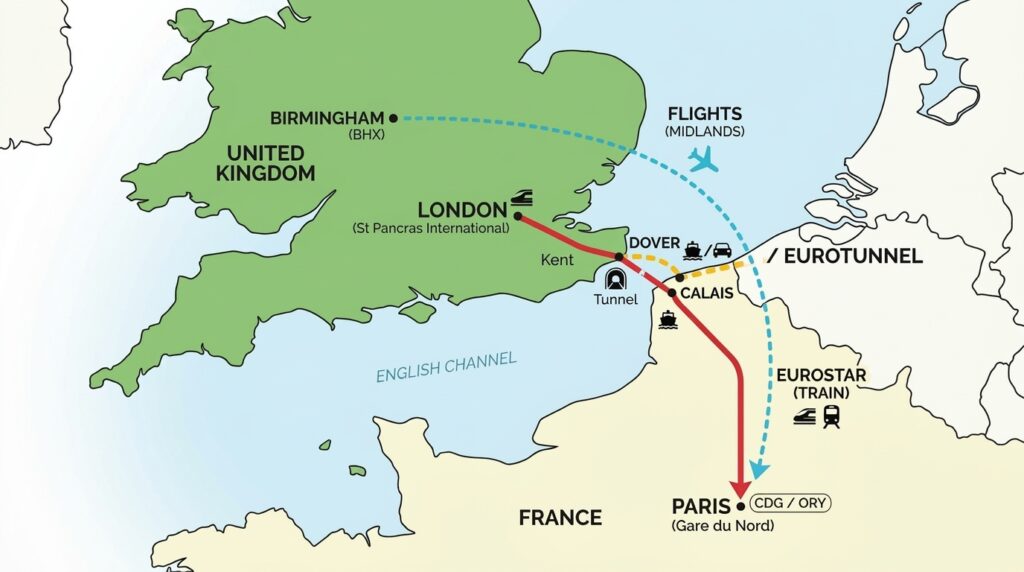
Planning a trip to Disneyland Paris from the UK? The good news is that getting from Britain to the magic is relatively straightforward, whether you choose to travel by Eurostar and train, fly to Paris, or drive from the UK.
The best option depends largely on where you’re travelling from in the UK, the size of your family, how much luggage you’re taking and whether you’re planning to visit Paris as part of your trip.
One important thing has changed in recent years: there is no longer a direct Eurostar service from London St Pancras to Disneyland Paris. You can still travel by Eurostar, but you’ll need to connect to another train before reaching Marne-la-Vallée Chessy, the station directly opposite the Disneyland Paris parks.
In this guide, we’ll explain all the main ways of travelling from the UK to Disneyland Paris, including:
- Eurostar from London to Disneyland Paris
- Flying from the UK to Paris
- Driving from the UK to Disneyland Paris
- Travelling from regional UK airports
- The best option for families
- What happens when you arrive at Disneyland Paris
- Which route we’d choose depending on where you’re starting your journey
At a glance: the best ways to get from the UK to Disneyland Paris
| Travel method | Best for | Approximate journey |
|---|---|---|
| Eurostar + connecting train | London & South East | Around 3–4 hours from London |
| Flying to Paris CDG | Midlands, North & Scotland | Around 4–5 hours door-to-door |
| Driving via LeShuttle | Larger families & lots of luggage | Around 5½–12 hours depending on UK starting point |
| Driving via ferry | Saving money on the Channel crossing | Slightly longer than LeShuttle |
These are broad planning estimates rather than guaranteed journey times. Your actual journey will depend on connections, traffic, border checks, flight times and your starting point.
Eurostar to Disneyland Paris from the UK
For many years, Eurostar was arguably the easiest way to travel from the UK to Disneyland Paris. You could board at London St Pancras and travel directly to Marne-la-Vallée Chessy, right next to the Disney parks.
That direct service is no longer running.
However, Eurostar Disneyland Paris journeys are still possible, and travelling by train remains an excellent option for many families — particularly those travelling from London and the South East.
Eurostar currently offers journeys from London St Pancras to Disneyland Paris with a connection at Lille or Paris.
Eurostar to Disneyland Paris via Lille
For most families, travelling via Lille is the route we’d recommend.
You travel:
London St Pancras → Lille Europe → Marne-la-Vallée Chessy
The first part of the journey is on Eurostar. At Lille Europe, you connect to a French high-speed service travelling onwards to Marne-la-Vallée Chessy.
And the best bit?
Marne-la-Vallée Chessy is directly opposite the entrance to Disneyland Paris.
You don’t need to travel into central Paris before heading back out towards the Disney parks.
Is changing trains at Lille difficult?
Not particularly.
Lille Europe is a relatively compact station, and you don’t need to navigate the Paris Metro with suitcases, children and pushchairs.
That makes the Lille route particularly attractive for families.
I’d still allow plenty of time for your connection rather than booking the absolute tightest possible change.
How long does Eurostar to Disneyland Paris take?
The fastest journeys can be around three hours from London to Marne-la-Vallée Chessy, although your actual journey will depend on the particular connection you book.
Remember that you also need to allow time at London St Pancras for Eurostar check-in and border procedures.
For most families, I’d think in terms of roughly four hours from central London to Disneyland Paris, rather than focusing too heavily on the fastest advertised train time.
How much does Eurostar to Disneyland Paris cost?
Prices vary enormously depending on your dates, how early you book and availability.
School holidays, weekends and popular Disney dates can be considerably more expensive.
One of the biggest advantages of travelling by train is that you avoid some of the additional time involved with flying — particularly getting to the airport, security, baggage collection and airport transfers.
It’s therefore worth comparing the total cost and total journey time, rather than simply comparing the headline ticket prices.
Eurostar to Disneyland Paris via Paris
The alternative is:
London St Pancras → Paris Gare du Nord → Marne-la-Vallée Chessy
From Gare du Nord, you’ll need to use Paris’s RER network, travelling via Châtelet-Les Halles before continuing on the RER A towards Marne-la-Vallée Chessy. Disneyland Paris states that the journey from Gare du Nord to the resort takes approximately one hour.
This route can work well if you’re combining Paris and Disneyland Paris in the same holiday.
For a family whose only destination is Disney, however, I’d generally favour the Lille connection because it avoids navigating the Paris Metro with luggage.
Flying to Disneyland Paris from the UK
Flying is often the best way to reach Disneyland Paris if you’re travelling from outside London and the South East.
For families in the Midlands, North of England, Wales or Scotland, it can make much more sense to fly from your local airport than travel all the way to London for Eurostar.
Which Paris airport is best for Disneyland Paris?
Paris Charles de Gaulle (CDG)
Charles de Gaulle is usually the best Paris airport for a Disneyland Paris holiday.
The airport is around 32 km from Disneyland Paris and has a direct TGV connection to Marne-la-Vallée Chessy.
This can make the final part of the journey surprisingly quick.
You can also travel from CDG to Disneyland Paris by RER, coach or private transfer.
Disneyland Paris from CDG by train
The TGV is the fastest rail option between CDG and Marne-la-Vallée Chessy when a suitable service is available.
The station at Marne-la-Vallée Chessy is right by the Disneyland Paris parks, making this an attractive option for families who don’t want to arrange a separate road transfer.
Disneyland Paris from CDG by Magical Shuttle
Disneyland Paris also offers the Magical Shuttle, a dedicated coach service between Paris airports and the Disneyland Paris resort.
This can be a particularly convenient option if you’re travelling with children and don’t want to deal with the Paris RER system after a flight.
What about Paris Orly?
Paris Orly can work, particularly if you find a significantly cheaper or more convenient flight.
However, CDG is generally the airport I’d look at first when booking a Disneyland Paris trip from the UK because of its location and transport connections to the resort.
What about Paris Beauvais?
Be careful with flights advertised as flying to “Paris Beauvais”.
Beauvais is a considerable distance from Paris itself and is much less convenient for Disneyland Paris.
A cheap flight to Beauvais can stop looking cheap once you’ve added the time and cost of getting from the airport to Disneyland Paris.
Which UK airports fly to Paris?
One of the biggest advantages of flying is the choice of departure airports.
Depending on the season and airline schedules, UK travellers can find Paris flights from airports including:
- London Heathrow
- London Gatwick
- London City
- Birmingham
- Manchester
- Edinburgh
- Glasgow
- Bristol
- Newcastle
- Leeds Bradford
Routes and airlines change regularly, so always check current schedules for your travel dates.
For families living in the Midlands or further north, flying from your nearest suitable airport can be much easier than travelling south to London first.
Driving to Disneyland Paris from the UK
Don’t overlook driving.
For some families, driving from the UK to Disneyland Paris is actually the easiest option.
You can pack as much as you reasonably need, there’s no airport security, you don’t have to worry about children’s luggage allowances and you can stop whenever you need to.
It’s particularly attractive for larger families.
The usual route is:
UK → Channel crossing → Calais → A26/A1 → A104/A4 → Disneyland Paris
The important thing to know is that you don’t need to drive through central Paris.
The Disneyland Paris resort is east of Paris and the main motorway route approaches the resort without taking you through the centre of the city.
LeShuttle vs ferry to Disneyland Paris
You have two main choices for crossing the English Channel with your car.
LeShuttle
LeShuttle takes approximately 35 minutes from Folkestone to Calais. Disneyland Paris quotes approximately 3½ hours of driving from Calais to the resort.
That makes the Channel Tunnel particularly attractive when you’re trying to get to Disneyland Paris as quickly as possible.
Ferry
You can also travel by ferry from Dover to Calais.
The crossing takes approximately 1½ hours, followed by roughly 3½ hours of driving to Disneyland Paris.
Ferry fares can sometimes be cheaper than LeShuttle, so it’s worth comparing both options for your dates.
For families travelling with pets, lots of luggage or children who enjoy getting out of the car, the ferry can also be a perfectly good choice.
How long does it take to drive from the UK to Disneyland Paris?
Your journey time depends enormously on where you live.
As a rough guide:
| Starting point | Approximate journey time |
|---|---|
| London / South East | 5½–6½ hours |
| Birmingham / Midlands | 6½–7½ hours |
| Manchester / North West | 8–9 hours |
| Leeds / Yorkshire | 8½–9½ hours |
| Newcastle / North East | 9½–10½ hours |
| Edinburgh | 11–12 hours |
These figures are planning estimates and include the Channel crossing. Traffic, stops, roadworks and Channel crossing availability can all make the journey longer.
For families travelling from Scotland or the far north of England, I’d seriously consider whether flying would be more comfortable.
How much are the French tolls to Disneyland Paris?
If you take the motorway route from Calais towards Disneyland Paris, you’ll encounter French péage tolls.
Make sure your sat-nav is not automatically set to avoid toll roads unless you specifically want to take the slower route.
The exact toll cost can change, so check current rates before travelling and include them in your holiday budget.
You’ll also need to budget for:
- Channel crossing
- Fuel
- French motorway tolls
- Parking, if applicable
- Food and drinks during the journey
For larger families, however, driving can still work out very competitively because you’re paying for the car rather than an individual ticket for every passenger.
Which is the best way to get to Disneyland Paris from the UK?
There’s no single answer.
The best option depends largely on where you’re starting from.
London and South East
Eurostar via Lille would be my first choice.
You avoid an airport, start from central London and arrive at Marne-la-Vallée Chessy, directly beside the Disneyland Paris parks.
Driving is another good option if you’re travelling with a large family or lots of luggage.
Midlands
I’d compare:
Flying from Birmingham vs driving.
For a smaller family, flying can be quicker.
For a larger family, the cost of flights and transfers can make driving much more attractive.
North West
For families around Manchester and Liverpool, I’d generally look at flying from Manchester first.
Driving is certainly possible, but it’s a long day behind the wheel.
Yorkshire and North East
Flying is usually the option I’d investigate first, particularly if you can find a convenient flight from Leeds Bradford or Newcastle.
Driving remains possible, but you’re looking at a substantial journey.
Scotland
For most Scottish families, flying is likely to be the most practical choice.
Driving from Edinburgh or Glasgow to Disneyland Paris is perfectly possible, but it’s a very long journey.
What happens when you arrive at Disneyland Paris?
Arriving by train
If you’re arriving at Marne-la-Vallée Chessy, you’ve already done most of the hard work.
The station is immediately beside the Disneyland Paris resort.
Disneyland Park and Disney Adventure World are both within walking distance of the station.
If you’re staying at a Disney Hotel or eligible partner accommodation, you can also arrange Disney Express luggage transfer in advance. Disneyland Paris says this allows guests to drop their luggage at the dedicated counter at the station and head straight into the parks while the luggage is transferred to the hotel.
Arriving by car
Follow the signs for your particular Disney Hotel or accommodation.
If you’re staying off-site, check the exact location of your hotel before setting off — “Disneyland Paris” isn’t necessarily the best final destination to put into your sat-nav.
Arriving by plane
If you’ve flown into CDG, you’ll need to choose between the available train, shuttle, coach or private-transfer options.
For families with young children and lots of luggage, paying a little extra for a straightforward transfer can sometimes be worth it.
So, what’s the best way to travel from the UK to Disneyland Paris?
For us, the decision would be:
London / South East: Eurostar via Lille
Midlands: Compare Birmingham flights with driving
North of England: Flying is usually the easiest
Scotland: Flying is generally the most practical
Large family + lots of luggage: Driving deserves serious consideration
Combining Disneyland Paris with Paris: Eurostar via Paris can make sense
There isn’t necessarily a “best” way to get to Disneyland Paris. The best option is the one that gives your family the right balance of price, journey time, convenience and stress.
And remember: the cheapest flight isn’t necessarily the cheapest journey once you’ve added airport parking, transfers, baggage and food. Equally, a train ticket that looks expensive can become much more competitive when you compare it with the complete cost of flying.
The magic starts when you leave home — so choose the journey that gets your family to Disneyland Paris feeling excited rather than exhausted!
Planning your Disneyland Paris holiday?
If you’re still putting your trip together, have a look at our other Disneyland Paris guides, including our recommendations for the best Disneyland Paris hotels for British visitors and our other planning guides.
Catherine made her first ´Once in a lifetime’ trip to Orlando in 2012 and only went to Disney World as the tickets were included in her holiday package. She followed with her first trip to Disney Paris in 2015. This led to what has become a no doubt lifelong obsession. When not excitedly talking to other Disney and Orlando lovers and potential travelers, she likes to tell people they don’t like it or don’t want to go that they are wrong.
Leave a Reply