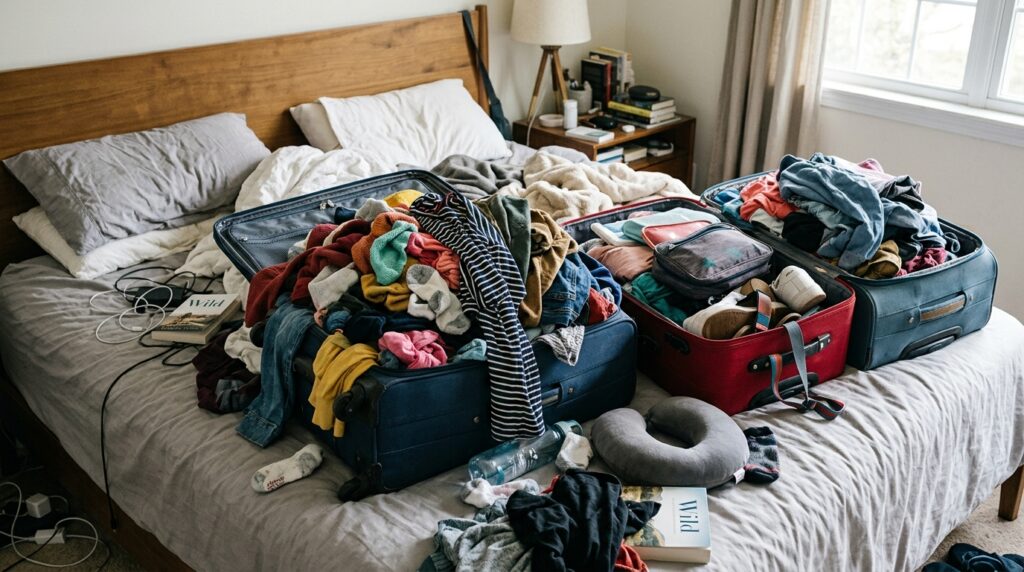
What to take, and also what not to take
Packing for Orlando is a different exercise to packing for a European holiday. You’re not just packing clothes for a week — you’re packing for ten-hour park days in Florida heat, transatlantic flights with children, US customs requirements, and a destination where forgetting the right thing on the wrong day can be genuinely expensive.
This guide is written specifically for British visitors, which means it covers the things American packing lists leave out entirely: plug adaptors, prescription medication rules, what to do about your Dyson Airwrap (hint, don’t) how much sun cream to bring versus buy, and what the parks will and won’t let through the gates.
Work through this in sections, use it as a checklist, and you’ll arrive at Orlando International Airport with everything you actually need and nothing you don’t.
Before you pack — a few things to sort first
These aren’t things to throw in a suitcase, but they belong at the top of any Orlando packing guide because forgetting them is far more consequential than forgetting your sun hat.
- ESTA. Every British visitor to the USA needs an ESTA (Electronic System for Travel Authorisation) before they board the plane. It costs around £35 at the time of writing, takes about ten minutes to complete online, and must be obtained from the official US government website at esta.cbp.dhs.gov. or official App. We’ve written a full guide to the ESTA application process. [Internal link: ESTA guide]
- Travel insurance. US medical costs are extraordinarily high. A standard European travel insurance policy will not cover you in Florida. Make sure your policy specifically covers the USA, includes medical evacuation, and has adequate cover for any pre-existing conditions. This is non-negotiable — sort it before you do anything else. See our article here about this.
- My Disney Experience app. Download it on every device in your party before you leave the UK. Set up accounts, link your Magic Tickets, add your dining reservations, and enable Lightning Lane booking. Doing all of this at home is significantly less stressful than doing it at the park gates in 32°C heat.
- Universal app. Same principle. Download, set up, and familiarise yourself before you fly.
- Fee-free travel card. If you don’t already have one, get a Wise, Starling, Revolut, or Halifax Clarity card before you go. Using a standard UK debit card in the US typically incurs a 2–3% foreign transaction fee on every purchase. On a two-week Orlando holiday, that adds up to a meaningful sum. A fee-free card costs nothing to get and eliminates the problem entirely. Get them and any credit cards set up on Apple or Google pay – American tills and such can behave differently to back home and your card provider may scream “who is this’ when trying to use it, using a phone based wallet here does seem to behave better and the card issuers and bank seem to trust it’s till ‘you’ when trying to pay for Disney parking or a restaurant bill. (On our travels last year, I kept having a complete brain escapism when asked for a PIN, at least with Apple pay I didn’t have to remember my own face).
Section 1 — Travel documents and essentials
These go in your hand luggage. All of them. Never checked baggage.
- Passports (check they’re valid for the full duration of your trip – there is no European style “plus six months” rule for the USA, the passports just need to be valid.
- ESTA confirmation printout or screenshot — technically the airline can see this electronically but having it saves any check-in confusion, or serves as a paper based comfort blanket at least.
- Travel insurance documents and emergency contact number.
- Flight confirmation and hotel booking confirmation printouts, and your boarding passes if you check in at home.
- Park ticket confirmation (printed or saved to your phone — you’ll need this at the gate if you don’t link your app before flying)
- Driving licence if hiring a car (and a credit card for check in for this).
- Credit and debit cards — take at least two different cards in case one is blocked for security reasons abroad (see my note above, this mostly happens when the till is expecting a swipe and your card issuer wants a PIN used, phone based wallet saves red faces here)
- Fee-free travel card (Wise, Starling, Revolut, or Halifax Clarity)
- A small amount of US dollars cash for tips, parking, and situations where card isn’t accepted – get this at a bureau de change near you (Post Office, Tesco, etc – please don’t want to the airport and get rinsed on the rate)
- European Health Insurance Card (EHIC) or its UK replacement (GHIC) — these don’t cover the US but are worth having if you’re making any European connections en route.
One important tip on cash: Florida’s tipping culture is real and unavoidable. Restaurant servers, hotel porters, taxi and rideshare drivers, and even some theme park food workers receive tips. 18–20% is standard at table service restaurants — budget for it and keep some dollar bills accessible for situations where card tipping isn’t convenient.
Section 2 — Electricals and adaptors
This is the section that we British visitors either over-think or completely forget about. Here’s what you actually need.
The plug adaptor — essential
The United States uses Type A and Type B plug sockets with a 120V, 60Hz electrical supply. British plugs (Type G, 230V, 50Hz) will not fit any American sockets — you need a UK to US plug adaptor.
Buy one or two before you go — they’re available cheaply on Amazon and in most travel accessory shops. The best option for a family is a multi-port adaptor with USB-A and USB-C sockets built in, so you can charge multiple devices from a single wall socket. Most Orlando hotel rooms have a limited number of US sockets, and a good multi-port adaptor solves the charging problem in one. You should find most hotels offer USB charging ports as well. I was pleasantly surprised with heaps of them in The Grove last year, in the lamps of all places.
The voltage question — read before you pack your hair appliances
This is where British visitors get caught out. The adaptor changes the plug shape but not the voltage. US electrical supply runs at 120V versus the UK’s 230V — and many hair appliances are single-voltage (220-240V only), meaning they will not work safely in the US regardless of what adaptor you use. That being said, do you really want to take that with you ? It’s heavy and that means less tat (sorry, merch) to bring back ! Most hotels and villas will have hair appliances you can use. Plus its so humid there’s only so much a hair straightener can do for you out there.
Most modern smartphones, laptops, and tablet chargers are dual-voltage (check the label — it will say 100-240V if it is) and work perfectly fine with just an adaptor.
The Dyson Airwrap situation deserves special mention. UK Dyson Airwrap models are single-voltage at 220-240V only. No adaptor or voltage converter will make them work safely in the US — Dyson explicitly states that using a voltage converter with the Airwrap damages the motor and voids the warranty. Leave it at home. The same applies to many UK hair dryers, GHD straighteners, and similar high-wattage appliances.
What to do instead: Most Orlando hotels provide a hair dryer in the room. Check before you travel whether your specific hotel includes one. If you need a straightener or Airwrap equivalent in Florida, either buy a US-voltage model when you arrive (Target and Walmart near the parks both sell them cheaply) or use your hotel’s facilities.
Electricals checklist
- UK to US plug adaptor (take two — one for bedroom, one for bathroom)
- Multi-port USB/USB-C charging hub
- Portable power bank — absolutely essential for long park days when your phone is running the Disney and Universal apps constantly. A 20,000mAh battery bank is the sweet spot for a family. A note here though, you MUST keep these with you in the aircraft cabin, for the love of whatever deity you may or may not worship, do NOT put these in your hold luggage. Also recommended that you do not use them on board, your airline will provide advice here.
- Phone charging cable (pack a spare — these are the most commonly lost travel item, or some grumpy teenager keeps pulling them by the cable and it breaks)
- Camera if you use one — most phones are sufficient for park photos, but Memory Maker in Disney and Universal’s photo service capture the ride photos
- Universal laptop charger (check the label says 100-240V)
- Children’s tablet chargers if applicable
- Earphones for the flight – I’d recommend a good pair of comfy noise cancelling ones. Especially if you get one of ‘those’ seat neighbours thats a little too….chatty.
Leave at home: UK hair dryers, single-voltage straighteners, Dyson Airwrap, any appliance that doesn’t explicitly say 100-240V on the label.
Section 3 — Clothing
Florida’s weather in summer is genuinely hot — consistently 32–36°C from June to September with high humidity. In winter (December to February) it’s pleasantly warm during the day (18–24°C) but can feel cool in the evenings, particularly after dark at outdoor parks. Pack accordingly for your travel dates. For out 2025 trip, we purposefully didn’t take a set of clothes for each day. If where you are staying has laundry facilities, use those and travel light. It gives you more luggage space to bring those must-purchase gifts and merch back with you, along with several tonnes of caramel cold brew M&Ms. (Come on Mars, sell these in the UK, please !). Take enough, but don’t overdo it. Let’s face it you’re gonna buy at least one t-shirt in the first couple of days anyway aren’t you ? (And the ones at Target can be good value)
The golden rule: comfortable shoes
This cannot be overstated. You will walk between 15,000 and 25,000 steps on a full park day. Shoes that aren’t properly broken in will result in blisters by day two and misery for the rest of the trip. Wear your park shoes for several weeks before you travel. Do not buy new trainers the week before you leave. Also don’t do what we did and buy new trainers in the outlets on the day we arrived. And then get them soaked in a rainstorm the following day….the blisters became legendary. Get some out there sure, there are bargains in the Vineland Outlets, great for when you are back home. You don’t want to have to make every day in Orlando a ‘two sock’ day to save your feet.
For summer visits (June–September)
- Light, breathable clothing — cotton or moisture-wicking fabrics. Florida humidity makes synthetic fabrics uncomfortable
- Shorts and t-shirts for park days. Comfortable casual clothing for evenings at Disney Springs or Universal CityWalk
- A light layer for air conditioning — Florida restaurants, shops, and transport are aggressively air-conditioned and can feel cold after hours in the heat outside. If you get cold in A/C, then a light zip-up hoodie or cardigan is useful – you lunatic 😉
- Swimwear — for the hotel pool, water parks, or lazy afternoon swims between park sessions. They will take a while to dry in the humidity, bear that in mind.
- One smarter outfit per adult if you’re planning table service restaurant evenings
- Comfortable walking shoes — properly broken in trainers or walking shoes. Not flip flops for park days (seriously, don’t do this)
- Flip flops or sandals for the hotel pool and casual evenings
- A rain poncho or lightweight waterproof jacket — Florida summer afternoons often produce brief but heavy thunderstorms. A poncho takes up almost no space and is dramatically cheaper to bring than to buy inside the parks
For winter visits (October–February)
- Layering pieces — a lightweight down jacket or fleece for evenings, especially November to February when temperatures can drop to 12–15°C after dark
- Still bring shorts and t-shirts for daytime — it will genuinely be warm enough
- Closed shoes rather than sandals for the cooler months
- A warmer jumper or layer for the flight home, which will feel genuinely cold after two weeks in Florida
For families with young children
- Several changes of clothes per child per day — water rides, ice cream incidents, and general small-child chaos require more changes than you’d pack for a European holiday
- Easy on-off shoes for children — theme park security and ride boarding is easier with shoes that don’t require untying
- Sun hats for young children — non-negotiable in summer
- Comfortable outfit per character dining reservation if you want photos
Section 4 — Sun care and toiletries
Sun cream — bring it from home
Sun cream is available everywhere in Florida but is significantly more expensive in the parks and resort shops than at home. A full day in the Florida sun without adequate protection is genuinely dangerous, particularly in summer — pack more than you think you need and apply it obsessively. Get it at Target / Walmart / CVS if you don’t pack any or run out.
SPF 50 is the minimum recommendation for Florida summer. Reef-safe formulations are required at Disney’s water parks. Pack sun cream in your checked luggage (the 100ml liquid rule applies to hand luggage) and decant a smaller amount into the park bag each day.
Park bag sun cream tip: Disney parks have no shade in many queue areas. Apply before you enter the park and re-apply after any water rides, at lunch, and mid-afternoon.
Other toiletries worth bringing from the UK
American pharmacies and supermarkets carry most toiletries, but bringing UK favourites avoids the faff of hunting for them on arrival:
- Aftersun lotion — you’ll use it
- Insect repellent — Florida has mosquitoes, particularly near Animal Kingdom and any outdoor areas in the evening
- Paracetamol (sold as Tylenol in the US but in different formulations that can confuse British visitors)
- Ibuprofen
- Antihistamines
- Any regular over-the-counter medication you rely on
- Children’s liquid paracetamol if travelling with young children — dosing guidelines differ in the US and having a UK formulation is simpler
- Blister plasters — because no matter how well broken in your shoes are, one day might catch you out
- Hand sanitiser
- Small first aid kit — plasters, antiseptic wipes, sports tape for blisters
Section 5 — Prescription medications
This is the section most packing guides skip entirely, and it’s worth reading carefully if any member of your party takes prescription medication.
The US Customs and Border Protection guidance is clear: you should keep prescription medication in its original container with the doctor’s instructions printed on the bottle. If you don’t have the original container, bring a copy of your prescription or a letter from your doctor explaining your condition and why you need the medication. Bring no more than a 90-day supply.
In practice, a British family taking standard prescription medication (blood pressure tablets, inhalers, antihistamines, contraceptives) will encounter no issues at US customs provided the medication is in labelled containers and the quantity is clearly for personal use during the trip.
What to do for ADHD medication and controlled substances: ADHD medications including methylphenidate (Ritalin) and dexamfetamine (Adderall equivalent) are controlled substances in the US. Controlled substances require particularly careful documentation — carry the original prescription, a letter from your GP confirming the diagnosis and treatment, and keep the medication in its original labelled packaging. Victoria’s guide to the DAS Pass and our ADHD and Autism category covers practical tips for managing neurodivergent needs in the parks specifically. [Internal link: ADHD and Autism category]
Always carry medication in hand luggage. If your checked baggage is delayed or lost, losing access to prescription medication is a serious problem. Keep everything you need in your carry-on bag. You get plenty of space on most transatlantic flights in the overheads / underseat.
The parks and medication: Disney World parks allow guests to bring any medication they need — keep it in its original labelled container for easy identification at the security bag check.
Section 6 — Your park bag
Your park bag is what you carry into the Disney and Universal parks each day. Getting this right makes a genuine difference to how comfortable your day is.
Bag size rules
Disney World’s bag policy limits bags to a maximum of 24 inches long x 15 inches wide x 18 inches high. Wheeled suitcases and bags larger than this are not permitted inside the parks. All bags are subject to a security search at park entry. Universal’s policy is similar. Most standard backpacks and crossbody bags are within the limits. For our 2025 trip, we found our park bags got lighter and lighter with each day. A frozen bottle of water in them seems to stay cold for some time in a crossbody bad. Avoid hard glasses cases, they will get you pulled aside in security at the parks (personal experience !)
The best bag style for park days: A small-to-medium backpack for families, or a crossbody/belt bag for adults and couples. A large, overstuffed rucksack is uncomfortable in queues, difficult to manage on rides, and harder to carry through a full park day than a lighter, compact option. The belt bag (sometimes called a bum bag in the UK) has become the go-to choice for many experienced park visitors — it stays close to your body, is easy to access without taking it off, and fits neatly in the ride storage cubbies.
What to put in the park bag
- Portable phone charger and USB cable — the Disney and Universal apps drain batteries relentlessly
- Water bottle — free water is available at any Disney quick service restaurant (just ask at the counter). A refillable water bottle saves you £15–£20 per day per person compared to buying bottles inside the parks
- Snacks — both Disney and Universal allow guests to bring their own food and snacks. A family of four bringing a packed lunch and mid-morning snacks can save £40–£60 per day compared to buying everything inside the parks
- Sun cream (small decanted amount for reapplication)
- Hand sanitiser
- Blister plasters (in case)
- Small first aid essentials
- Poncho or lightweight waterproof — takes up almost no space, completely transforms a rainy afternoon
- Any prescription medication needed during the day
- Sunglasses
- Portable fan — a small USB or battery-powered mini fan is one of the most used items in a summer park bag and costs almost nothing
- For families: nappies and wipes if needed, children’s snacks, any comfort items for young children
What not to bring
Glass containers (with the exception of small baby food jars), selfie sticks, and any item deemed suspicious are prohibited at Disney parks. At Animal Kingdom specifically, balloons and plastic straws are also not permitted. Magicalguides
Leave the selfie stick at the hotel — security will make you take it back. Memory Maker (included with your UK Magic Ticket) and the parks’ own PhotoPass photographers cover the group photos. Phones are fine for your own stills and video. Vloggers might take a full on camera, but for us that’s just another thing to worry about and more stuff in the bag (and then, where does the merch go ?)
Section 7 — For families with young children
A few additional items worth flagging specifically for families with babies, toddlers, or younger children.
Pushchair or stroller: Both Disney World and Universal permit pushchairs/strollers in all parks. Disney provides pushchair parking areas outside attractions. A lightweight, compact travel pushchair is infinitely easier to manage than a large full-size model. Disney also rents pushchairs on-site if you’d rather not travel with one, though the rental options are single or double hard-plastic strollers without any customisation.
Baby changing: Both resorts have baby care centres with changing facilities, feeding areas, and basic supplies (nappies, formula, baby food) for sale. Disney’s Baby Care Centres are more extensive — there’s one in each park.
Ear defenders for noise-sensitive children: Theme park shows, parades, and fireworks are loud. Small, portable ear defenders for young children or sensory-sensitive visitors are worth packing. See our DAS Pass guide for more on managing sensory needs in the parks.
Glow items for evening park visits: If you’re staying for evening parades and fireworks (you should — they’re magical), young children love the light-up accessories sold in the parks. These are significantly cheaper on Amazon before you travel than inside the parks on the night.
Section 8 — What to buy in Florida rather than bring
Florida is genuinely good value for certain purchases — considerably cheaper than the UK for some items. Here’s what’s worth buying there rather than packing from home.
Trainers and sportswear. Nike, Adidas, New Balance, and similar brands are significantly cheaper in Florida than in the UK. A pair of trainers that costs £120 at home might be £70–£80 equivalent in Florida. If you need new park shoes, buy them on arrival day and give your feet at least a day to adjust before a full park day – though seem my thoughts above about the folly of this, if you get it wrong).
Children’s clothing. American children’s clothing brands — Carter’s, Old Navy, Gap Kids — are very competitively priced and widely available near the parks. If your children need new clothes for the trip, buy them when you arrive rather than before.
Souvenirs and Disney merchandise. Obviously. The Disney and Universal shops are full of things unavailable at home. Budget for this — and note that merchandise is often cheaper on Disney Springs and CityWalk than inside the parks themselves or in Target, the Character Warehouses, and especially the legendary ‘gift’ shops on the I-192 and International Drive (looking at you giant wizard gift shop entrance).
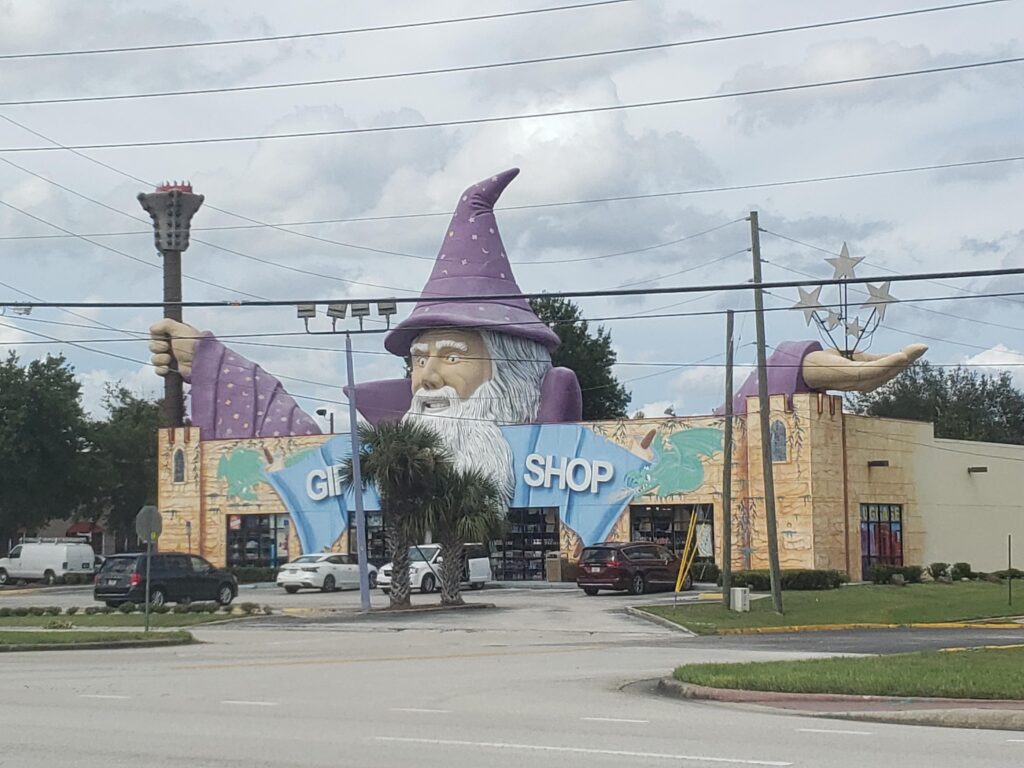
See ? I wasn’t kidding ! ‘Murica !
Over-the-counter US medication. Nyquil, DayQuil, and American-formulation cold and flu remedies are popular to bring home. Check UK customs allowances before you pack them for the return journey. UK customs allows £390 of personal goods brought back from the US before duty applies.
What to leave in Florida: Pepper spray (legal in Florida, classified as a firearm in the UK), any wildlife products, and anything you’re unsure about — check UK customs guidance before buying. Seriously, who tries to bring that home ?
Section 9 — The flight packing list
A 9–10 hour transatlantic flight deserves its own preparation. These are the carry-on essentials for the journey.
- All travel documents (passports, ESTA, insurance, bookings)
- All prescription medication
- Change of clothes for every child (accidents and spills happen on long flights)
- One change of clothes per adult in hand luggage — checked baggage delays can leave you stranded without a change
- Tablet or laptop with downloaded films, shows, and games for children. Do not rely on in-flight Wi-Fi
- Headphones — over-ear noise-cancelling headphones are transformative on a transatlantic flight
- Snacks — particularly for children, who may not want the airline meals
- Neck pillow and eye mask for overnight sections of the flight
- Empty water bottle to fill after security
- Lip balm and moisturiser — aircraft cabins are very dry on long-haul flights
- Chewing gum or sweets for children during descent — helps with ear pressure
The master checklist at a glance
A quick single-page summary to print or screenshot before you pack.
- Documents: Passports, ESTA, insurance, flight/hotel confirmations, park tickets, driving licence, cards
- Electricals: UK-US plug adaptors (x2), multi-port USB hub, portable power bank, phone cables (+ spare), camera, earphones, laptop (dual-voltage checked)
- Clothing: Comfortable broken-in shoes (critical), light breathable clothes, swimming costumes, light layer for air con, rain ponchos, sun hats, one smart outfit per adult
- Sun and toiletries: SPF50 sun cream (generous supply), aftersun, insect repellent, paracetamol, ibuprofen, antihistamines, blister plasters, first aid basics
- Medication: All prescription medication in original labelled containers, doctor’s letter for controlled substances, copy of prescriptions, carry in hand luggage only
- Park bag: Power bank, water bottle, snacks, sun cream, poncho, hand sanitiser, blister plasters, portable fan (summer), ear defenders (young children)
- Flight bag: All documents, medication, children’s change of clothes, entertainment downloads, snacks, neck pillow, eye mask, empty water bottle
One final thought
The temptation when packing for a two-week Orlando holiday is to pack for every possible scenario. Resist it. Florida heat means lighter clothing is more comfortable, the parks have everything you genuinely need to buy in an emergency, and a heavy suitcase at MCO baggage claim after ten hours of flying and a full day of travel is nobody’s idea of a good start.
Pack what you need, bring what’s hard to replace or significantly cheaper at home, and trust that anything you’ve forgotten can be solved at a Walmart or Target near the parks for less than you’d think.
Ready to find your hotel? Browse our full collection of hand-picked Orlando hotels reviewed for UK visitors, with options at every budget level.
Leave a Reply