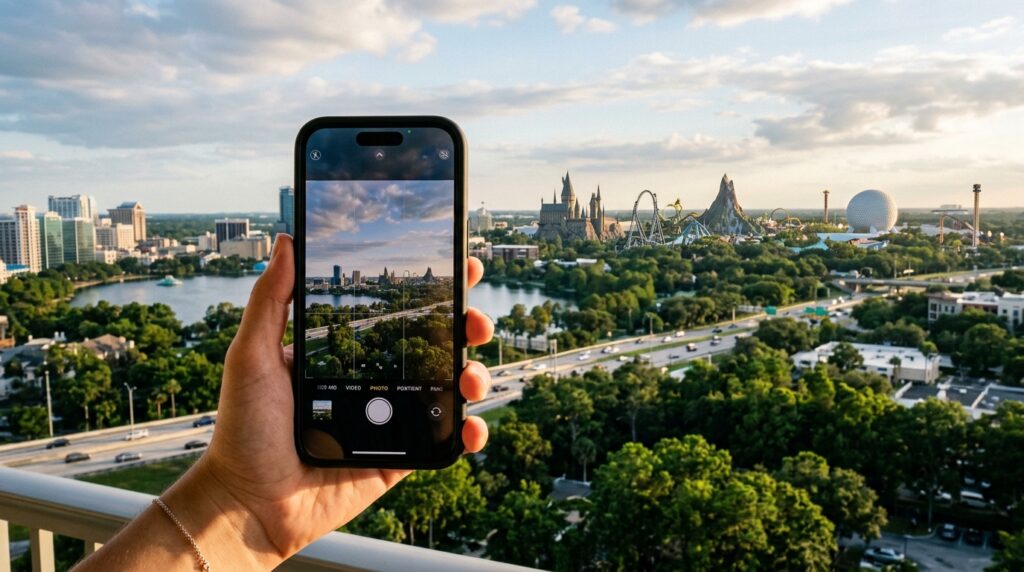
In the modern world, staying connected isn’t a luxury, its a necessity, and nowhere is this more true than from the moment you land in a US airport. From a personal experience, last year (2025) having a useful data connection from landing what invaluable, it let me make use of the Mobile Passport Control (MPC) app which took some of the stress away of the long queues at immigration (see our related article about ESTA’s and entry to the USA here). From letting relatives back home you’ve landed safely (apparently that’s still a thing, like your friends and family can’t use FlightRadar 24…sheesh !), but I’d also say that data is also probably more important that voice / texts, as these days most people can route calls and texts over data anyway.
There are a number of ways you can stay connected.
- Use an e-sim – probably the most cost effectively and popular method, though the use of them can be confusing to some at first, it enables you to seemlessly and cheaply connect to local mobile data services, whilst still keeping your UK phone number for texts and calls.
- Your UK mobile provider will normally have a way of using a partner network in the US. Whilst this will be seamless (you’ll get a text on landing if you’ve left mobile data switched on) it can get pricey. Some providers however do let you switch on an ‘add on’ package which can work out cheaper, but not as good value as an E-SIM. But hey, you’ll literally only have to take your phone off airplane on landing, and be good to go.
- E-SIMS only work if you have a phone that can use them. In 2026, thats probably most iphones and android devices made in the last few years. However if your phone doesn’t, and / or you don’t feel like paying your telephony provider any more, there is a third way, though it won’t work on landing. Once out of the airport, make a beeline for a nearby store that sells pay as you go SIMS. You can load that up with the data and even voice and texts you need. This does mean taking your normal SIM out of the phone, so keep that safe somewhere, and it will mean using a US number, so friends and family back home will (a) need to know the number and (b) be charged a pretty penny to call it. Some phones may have two SIM slots though, which may give you the best of both worlds. Whilst it’s a bit of a pain to get going this way, there is one advantage in that with a US number, you will find using some services (like a grocery delivery app or texts from hotel reception) may be more likely to work.
Ok there is a fourth way, though we wouldn’t recommend it, and that’s to skip mobile data altogether and just use free wi-fi whenever you can find it. In park and in hotel / villa may be enough, HOWEVER (a rare use of capitals to show how serious I am here) if you’re going to do this, please ensure you are using a reputable VPN for anything other than maybe simple web browsing. Even with in park wifi, it woudn’t be impossible for some less salubrious individuals to be bad actors here and sniff out sensitive information. If in doubt, turn your VPN on.
That being said, out and about in parks, you’ll find their wifi is pretty rock solid, despite the number of people using it. it’s impertive for things like lightning lanes and booking that snacky snack so they work hard to ensure it stays on. (But as a I say, use a VPN for anything not park related).
What phones work with E-Sims ?
Most popular smartphones have the option for an eSIM. Examples of phones that are eSIM compatible include (this isn’t an exhuastive list, just examples) :
- iPhone 14, 15 and 16 and 17 series
- Samsung Galaxy S22, S23, S24 and S25 series
- Samsung Galaxy Fold 7
- Samsung Galaxy Flip 7
- Google Pixel 8, 9 and 10 series
So with all of the above, what e-SIM options are available to you ?
Here’s how the three stack up for a UK traveller heading to the US – note the pricing may vary due to changes in the £/$ exchange rate :
Saily – https://saily.com
- Price: Cheapest entry point — 1GB/7 days from about £2.95, with fixed-data plans up to 30GB/90 days around £89. A 10GB for 30 days plan costs £17.99 , essentially matching Airalo’s equivalent.
- Network: Connects to T-Mobile and AT&T, generally solid coverage.
- Catches: Data-only — no US phone number or SMS, so you’d rely on WhatsApp/iMessage for messaging. Made by the NordVPN team, so it bundles in a verified ad blocker and virtual location/privacy tools — a nice extra if you care about security on public wifi.
- Best for: Budget-conscious travellers who mainly need maps, socials and messaging, and don’t need a callable US number.
Airalo – https://www.airalo.com
- Price: Similarly cheap entry (from ~£3), plans ranging £4.45–£44 for 1GB to 50GB over 3–30 days.
- Network: Uses local partner networks (Airalo’s USA plans run over T-Mobile or AT&T, with T-Mobile better for cities and AT&T better for rural areas like the South) — as a marketplace it offers more plan variety than most competitors.
- Standout feature: Unlike Saily, some Airalo US plans include an actual +1 phone number with inbound/outbound calls and SMS — genuinely useful if you need to book restaurants, deal with car hire, or receive SMS verification codes from US businesses.
- Catches: Reviews mention patchy customer support (slow AI chatbot before reaching a human), and as a marketplace, plan quality/network varies by which underlying operator you pick, so check the fine print before buying.
Holafly – https://esim.holafly.com
- Price: The priciest of the three, but sells unlimited data rather than fixed GB — around £35.50 for 15 days unlimited, i.e. roughly £2.90/day flat rate for the US specifically.
- Network: Good coverage including Alaska (Saily and some others don’t cover Alaska). Not that matters here at Mouse to Wand but we thought it was interesting !
- Catches: “Unlimited” is fair-use limited — just 500MB/day of hotspot/tethering allowance, and speeds throttle to 256–1024 Kbps once you cross roughly 90GB in a month. No phone number either, same as Saily.
- Best for: Heavy data users (streaming, video calls, lots of navigation) who want to stop thinking about GB limits entirely and don’t mind paying a premium for that peace of mind.
Bottom line for a typical UK–US holiday
- Short trip, light use, tightest budget: Saily — cheapest per-GB, decent network, handy privacy extras.
- If you need a genuine US number (food deliveries, restaurant bookings, 2FA texts): Airalo is the only one of the three offering that.
- Heavy data user, don’t want to monitor usage, willing to pay more: Holafly, but check the hotspot/throttle limits fit your needs (e.g. if you plan to hotspot a laptop a lot, 500MB/day may be tight).
One practical note regardless of provider: check your phone isn’t carrier-locked before you leave the UK (locked phones can’t add a second eSIM), and set up/download the eSIM on hotel or home wifi before you need it, since installation requires an internet connection.
How much data will I need ?
The the answer to this depends on what you will be doing, how long you will be there, and more. However if cost is a consideration, my advice would be to buy a reasonable amount (10Gb for 2 weeks for example) as your baseline. You can always top up if need be. For 16 nights in 2026, I used Saily’s 10Gb service and it was used in the hotel (as their wifi was iffy) for browsing, booking tickets, youtube and as a hotspot for the kids to connect through (and there’s a cost saving consideration for you), as well as all the Apple car play streaming music and in car navigation. When i got home, I’d used about 7Gb. Your mileage may vary of course but I felt that was £20 well spent. (I think it was around that amount at least).
If the hotel’s WiFi I stayed in last year hadn’t been so…asthmatic…. I reckon 2 to 3 Gb would have been plenty. It depends how hard you hit the Tube and the Gram and how often you video call gran back home of course.
Other Thoughts
If you have a banking service in any form with places like Revolut you may find their app also includes offers on their own e-SIM, these may be better value, but I’m not able to assess their performance against the ones listed above.
In short – I, well, we, recommend an eSim for a Florida or LA trip. There are plenty of options and I’d have no issues using any of the ones listed here, and can personally state from experience that the Saily app and service works, and is good value from my experience. I’ve no reason to suspect the others are any different. I was grateful to know I wasn’t going to get some massive bill from O2 when I got home. The relatively small cost against the whole holiday is very slight and the benefits really stack up.
Leave a Reply